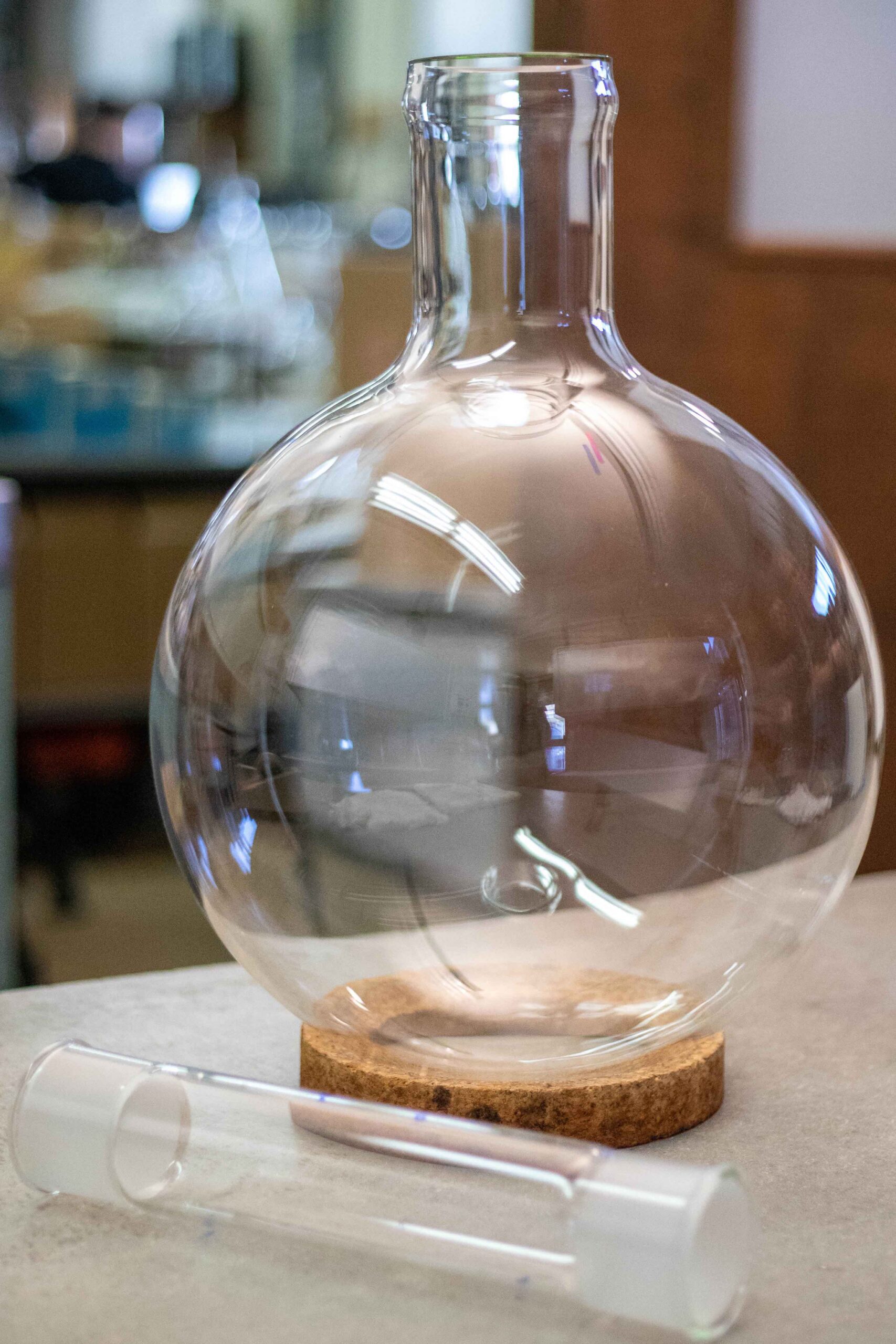
When a round bottom flask cracks mid-campaign or your rig needs a joint no catalog carries, the wait for a replacement stalls everything. At-Mar Glass forms every borosilicate glass round bottom flask in-house at our Kennett Square bench, single-neck to four-neck, matched to your apparatus instead of a generic mold. Call us to order or spec a build.
Which round-bottom you should order depends on what you’re putting it through. Heat, vacuum, and volume each stress the glass differently, and each points toward a different spec.
A round bottom flask for distillation relies on the sphere presenting a uniform surface to a mantle or bath. Heat wraps the curve evenly, driving smooth, controllable boiling instead of the hot spots and bumping that plague vessels built with flat bases and sharp interior angles.
Under reduced pressure, round bottom flasks outperform angular glassware because a sphere carries external load in even tension rather than concentrating it at a seam. That geometry, paired with heavy-wall construction, is precisely why they endure repeated vacuum distillation and solvent-stripping cycles without deforming.
Capacity magnifies these advantages. A large round bottom flask in the multi-liter range depends entirely on that self-supporting curve to bear its own filled weight, which is why pilot-scale synthesis and bulk distillation default to spherical vessels rather than flat-bottomed alternatives that would fatigue.


Neck count is where a round-bottom flask gets matched to its method. One opening or four changes what you can run simultaneously, and we build across the full range plus anything off-catalog.
The single-neck form is the everyday workhorse for reflux, rotary evaporation, and straightforward heating. One standard-taper joint keeps the setup clean and the interior easy to charge, empty, and rinse, which makes it the default choice for the vast majority of single-condenser reactions.
A three neck round bottom flask lets you run a condenser, a stirrer, and a thermometer or addition funnel at once, and we build two-, three-, and four-neck versions as reaction apparatus with the joint sizes and neck angles your setup demands.
Some reactions need a neck angle, joint, or sidearm that no catalog lists. Those are custom glassware jobs, and they start with a sketch or a spec sheet. Our glassblowers work from your requirements and fabricate the vessel to match your existing rig exactly.
Our stock spans single-neck through four-neck bodies in capacities from 50 mL up past 20 liters. A 1000ml flask round bottom is one of the most requested, though joint size and neck count vary by product. Each option below links to its live page.
Two flasks with identical specs can still come from very different suppliers. The distance between them shows up in how the glass is made, priced, and supported after it reaches your bench.
The entire flask, from body to joints to final finishing, is augmented and completed in-house at our Kennett Square facility. Decades of bench experience sit behind every piece, and no part of the job is farmed out to an outside subcontractor.
Because the work stays in-house, the cost reflects craftsmanship rather than a chain of resellers each taking a cut. That keeps research-grade round-bottom flasks affordable whether you’re replacing a single vessel or standardizing glassware across an entire research department.
A chipped joint or a cracked neck doesn’t have to mean weeks of downtime. Send it in and, depending on the damage, our glass repair service can often restore the flask and return it inside a single weekend turnaround.
The questions below come up regularly from people speccing round-bottom flasks for real synthesis and separation work. The answers assume you know the fundamentals and focus on the details that actually change what you should order for a given method.
The round bottom flask function spans any procedure involving sustained heat or reduced pressure: reflux, distillation, solvent evaporation, and multi-step synthesis. Its curved base heats evenly and withstands vacuum, which is why it anchors most rotary evaporators, heating mantles, and reaction manifolds in a working lab.
Because it can’t sit flat, a round-bottom flask pairs with a round bottom flask heating mantle that cradles the sphere and delivers uniform, contact heat across the curve. Mantles also avoid the localized hot spots and thermal shock that open flames or hotplates would impose on the glass.
A long necked round bottom flask buys vertical distance between the heat source and the joint, which protects thermometer adapters, condensers, and seals from excess heat during prolonged distillation. Specify the longer neck when your reaction runs hot for hours or when headspace above the mantle is tight.
A round bottom flask for rotary evaporator use needs a joint that mates to the evaporator’s vapor duct and a shape that tolerates rotation under vacuum while heated. The spherical body maximizes surface area as it spins, accelerating gentle, even solvent removal without bumping.
The volumetric flask vs round bottom flask decision comes down to what each is built to do. A volumetric flask guarantees a single calibrated fill line for quantitative work. A round-bottom carries no meaningful graduations at all, so its liquid level should never stand in for a real measurement.
Whether you need a single-neck flask off the shelf, a four-neck reaction vessel, or a fully custom build, we’re ready to make it. Reach out with your capacity, joint sizes, and neck count, and we’ll get your round-bottom flasks into production or on their way.