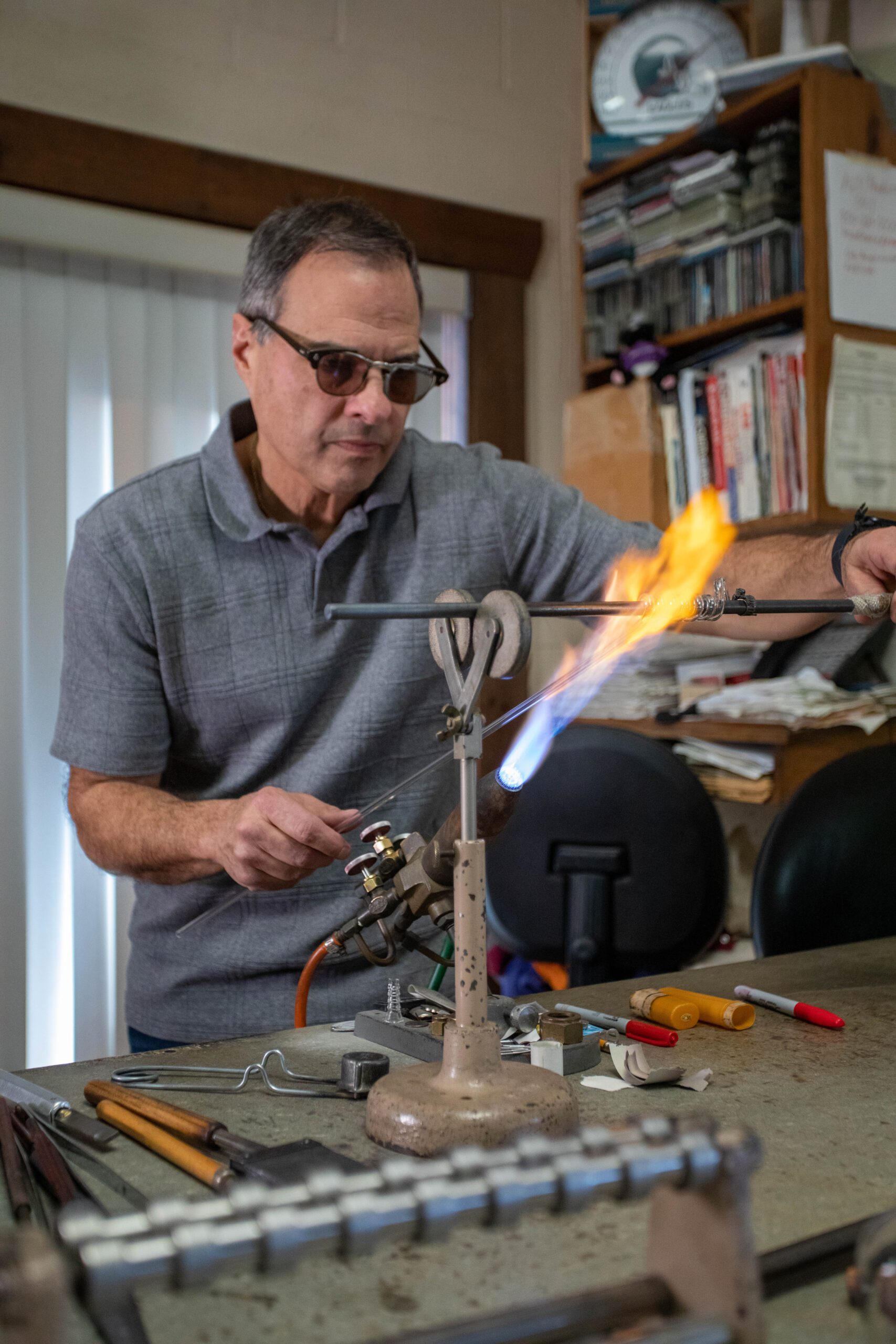
Sourcing an erlenmeyer flask that holds up to repeated thermal cycling, vacuum, and aggressive reagents means scrutinizing the glass long before the price. At-Mar Glass shapes every borosilicate erlenmeyer flask in-house at our Kennett Square, PA facility, where decades of glassblowing experience show up in the wall uniformity and joint precision your protocols depend on. Call us to order stock sizes, bulk runs, or a custom build.
Two flasks can look identical and perform nothing alike. What separates research-grade glassware from a stockroom commodity lives in details a product photo never captures: the glass chemistry, the evenness of the walls, and the precision of every ground joint. Those are the variables worth scrutinizing before you order.
Learn More
A quality glass erlenmeyer flask starts with Type I borosilicate, prized for its low thermal expansion and resistance to sudden temperature swings. That composition is what lets the vessel move from hotplate to ice bath without crazing, and what keeps it chemically inert against the reagents your work routinely subjects it to.
Beyond composition, a laboratory erlenmeyer flask earns its reliability through fabrication. Uniform wall thickness distributes mechanical and thermal stress evenly, proper annealing removes the residual strain that seeds cracks, and a cleanly ground standard-taper joint seals against adapters without leaks or wobble under vacuum.
Repeated heating and cooling punishes weak glass, which is why erlenmeyer flask dimensions and wall construction matter as much as capacity. Heavy-wall builds resist deformation and fatigue across hundreds of cycles, holding their shape, their seal, and their graduation accuracy long after thinner vessels have failed.
Erlenmeyer Flasks


At-Mar’s catalog centers on heavy-wall, standard-taper flasks, but the bench handles far more than what’s listed. When a protocol calls for geometry the catalog doesn’t cover, we fabricate it from scratch rather than pointing you toward a compromise. Here’s where the in-house range opens up.
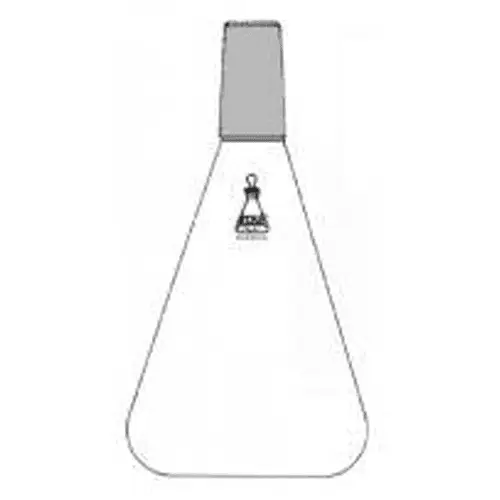
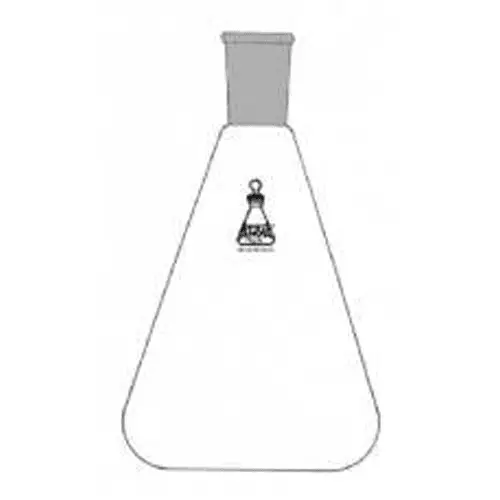
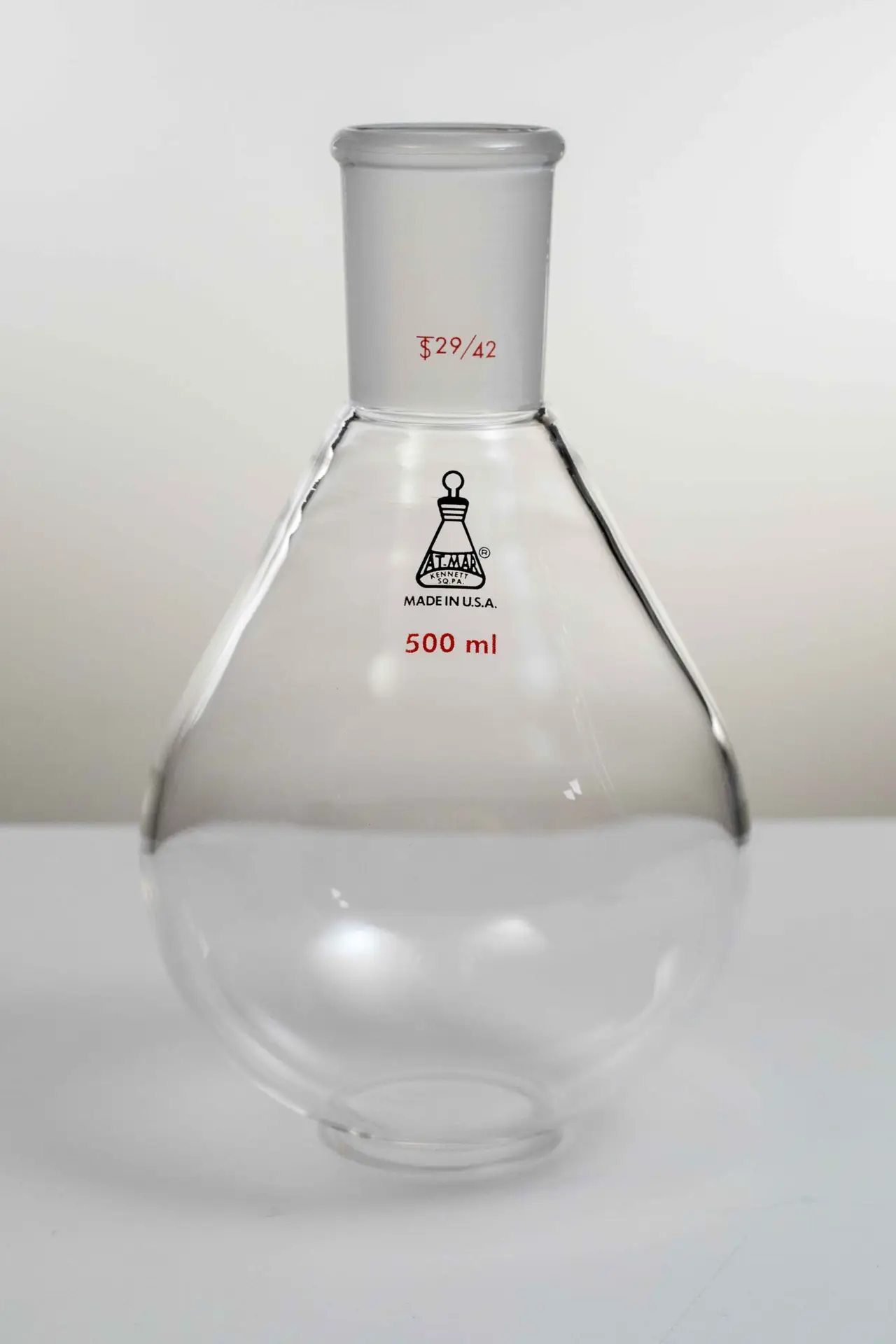
An erlenmeyer flask with stopper depends on a precisely ground joint, which is why our necks are cut to standard-taper sizes that mate cleanly with glass stoppers, condensers, and adapters. That interchangeability lets you build closed, leak-tight systems without hunting for a matching fitting.
A cell culture erlenmeyer flask carries different demands: generous headspace for gas exchange, smooth interior surfaces, and consistent capacity for reproducible growth conditions. We build these for biotech and microbiology labs to the exact volume and neck style your incubator shakers and closure systems require.
When nothing standard fits, a custom erlenmeyer flask is simply a conversation with our glassblowers who build to spec. Non-standard volumes, unusual joint sizes, added sidearms, modified necks: bring the drawing or the problem, and we shape the vessel around your apparatus instead of forcing your setup to adapt.
Our stocked erlenmeyer flask sizes run heavy-wall with ground standard-taper joints, built for apparatus work rather than open-bench pouring. Each option below links to its live product page. Need a volume or joint that isn’t listed? That’s a custom build, and we make those every week.
Buying glassware is easy. Building a supplier relationship that survives a rush order, a broken vessel, or a one-off modification is harder. Labs that work with us tend to stay, and the reasons come down to where the work happens, what it costs, and how fast we turn it around.
Working with an erlenmeyer flask manufacturer that outsources means every modification travels through a middleman. We don't operate that way. Every flask is shaped, jointed, and augmented to your requirements at our Kennett Square facility by glassblowers with decades at the torch, so nothing gets lost between your spec and the bench.
Quality glass shouldn't carry a punishing markup. We set our erlenmeyer flask price to reflect the actual craftsmanship involved, not a distributor's margin stacked on top of it. That keeps research-grade vessels within reach whether you're outfitting a single bench or restocking an entire teaching lab.
Ordering wholesale erlenmeyer flasks for a facility-wide standardization is routine for us, and so is repairing a damaged flask before your next experiment. Depending on the damage, a cracked or chipped vessel can be mended and back in your hands within a weekend rather than gone for weeks.
A few questions come up often enough, from seasoned chemists and new lab managers alike, that they’re worth answering directly. Here’s the practical detail behind what we field most about specification, selection, and the differences that actually affect results at the bench.
Speccing against a wide mouth erlenmeyer flask trades solids-handling ease for a tighter evaporation and containment profile, since the narrow bore restricts vapor loss and seats standard stoppers more securely. Wide mouths favor rapid solids charging, probe insertion, and cleaning. The decision usually tracks whether your protocol leans toward volatile liquids or frequent solid additions.
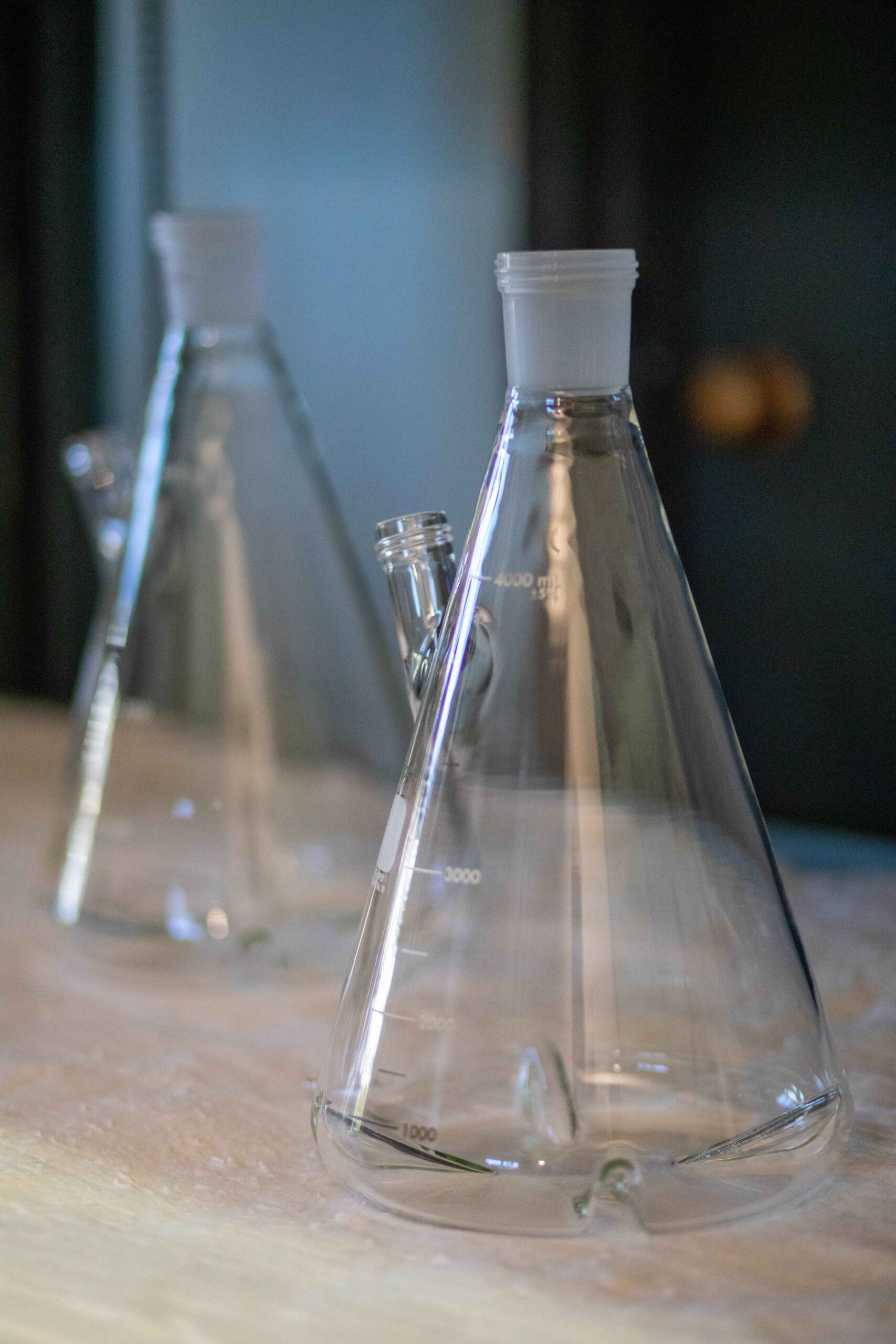
A graduated erlenmeyer flask carries markings intended for at-a-glance reference, generally within roughly five percent, since the wide base geometry makes the meniscus far less resolvable than in a narrow-neck vessel. Treat them as process indicators during a reaction, and defer to a Class A volumetric flask or cylinder anytime the figure feeds a calculation.
The erlenmeyer flask vs volumetric flask choice is really a question of what tolerance your step demands. The Erlenmeyer is a working vessel: mixing, heating, titration, crystallization. The volumetric certifies one calibrated volume for standard prep and quantitative dilution. Using an Erlenmeyer where a certified volume is required is a common source of avoidable error.
The erlenmeyer flask function is driven entirely by its taper. The narrowing neck concentrates contents toward the base for endpoint visibility in titration, suppresses evaporative loss during heating, and, in baffled shake-culture variants, promotes the vortex disruption that drives oxygen transfer. Few vessel geometries do this much work with so little complexity.
The erlenmeyer flask vs beaker distinction matters most under agitation. The tapered neck lets you swirl aggressively or stir at speed without splashout, and it accepts a stopper for closed or inert-atmosphere work, something a beaker’s open pour spout can’t offer. Beakers still win where open access and straightforward decanting are the priority.
It’s called an erlenmeyer flask because in 1860 Emil Erlenmeyer devised the form. What’s notable to a modern user isn’t the name but the staying power: the geometry was optimized so well for mixing and heating that a century and a half of labware innovation hasn’t displaced it.
When you’re ready to buy erlenmeyer flask stock, place a bulk order, or spec a custom build, our glassblowers are ready to help. Call or reach out today, tell us the capacity, joints, and modifications you need, and we’ll get your glassware moving, whether it’s a single flask, a facility-wide run, or a repair.